

Key points:
- The United Methodist Church uses a multidimensional approach, including community-based agricultural initiatives, to combat interethnic conflict in the Eastern Congo Episcopal Area.
- Communal fields and livestock activities foster peaceful cohabitation and promote peace between members of rival ethnic groups.
- Bishop Gabriel Yemba Unda, resident bishop and legal representative of The United Methodist Church in Eastern Congo, stresses the importance of peace to advance God's work in the region.
As the eastern part of Congo struggles with intercommunity conflict and a persistent food crisis, The United Methodist Church continues its peace-building efforts with new programs.
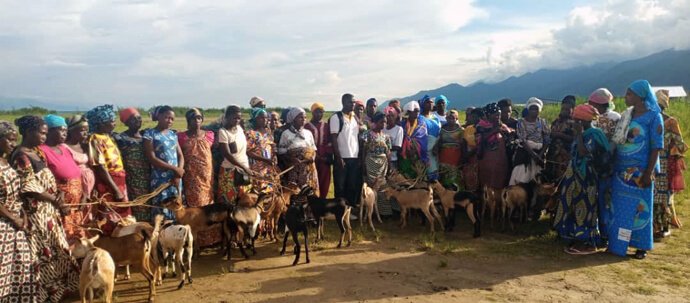
Funding from Connexio Switzerland, a mission organization of The United Methodist Church in Switzerland, has enabled the church to develop initiatives to facilitate cohabitation between rival communities. Ethnic groups, long at odds with each other, now cultivate communal fields together and raise goats and sheep in the Haut-Plateau region of the Uvira Territory.
Rose Nabintu, a Kivu peace mediator, said this innovative agricultural effort by The United Methodist Church enables women from different tribes to cultivate the land together.
“This bold initiative,” he said, “creates a space for dialogue and collaboration, fostering mutual understanding and social cohesion. Women from different communities come together to cultivate the land, giving them the opportunity to talk to each other and exchange their life experiences, and these communities are even beginning to intermarry.”
Bishop Gabriel Yemba Unda, resident bishop of the Eastern Congo Episcopal Area and legal representative of The United Methodist Church in the region, said that peace is vital to advancing God’s work in the region.
“Evangelization goes hand in hand with peace,” he said, pointing out that it is difficult for the church to go and preach the good news amid violence. “As Christians, we are, therefore, obliged to bring peace everywhere.”
For decades, intercommunity conflicts have troubled the eastern part of the country, leading to the creation of boundaries between communities.
Michel Kizibisha, who heads the projects department of the Kivu Conference, said that to achieve harmony, the church developed peace initiatives.
“In the past,” he said, “we’ve organized training seminars, awareness-raising events, evangelical crusades and musical evenings on the theme of peace.”
Despite these approaches, Kizibisha said, “intercommunity conflicts have intensified in the region. We changed our approach by involving women and different communities from different tribes to work together to create a meeting point.”
Alexis Busare of the Benyamulenge community, the father of six and a farmer and cultivator by trade, lives in the Haut Plateau region of Uvira. He said the church’s initiative enabled him to experience what he could not have imagined possible a few years ago: His son married a rival Bembe woman.
Busare pledged to continue working to promote peaceful cohabitation between communities in the plateau. “I want to show other communities that we must not create boundaries between us, the people of God,” he said.
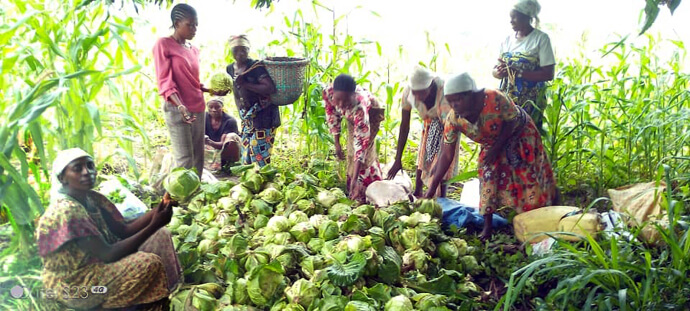
In addition to facilitating peaceful cohabitation, community fields and livestock activities enable local community members to cope with economic problems.
According to Nabintu, communities are facing food crises in their respective families.
Subscribe to our
e-newsletter
Chantal Naweza is the mother of eight, a homemaker and a farmer in the Ubwari community. She said that the recent harvest was good, helping to solve some of her family’s economic problems.
“We have just harvested tons of corn and eggplants,” she said, “which provide us with food for our families and the financial means to meet our families’ needs.”
Nabintu explained that after the harvest, the communities set aside part of it for seeds.
“Another part was sold to create microcredits,” he said, “favoring the economic empowerment of these communities in their daily lives, while promoting peace between different communities. It is a great satisfaction to see today the harvest of several bags of eggplant and cabbage that we have just obtained, as well as the good development of goat breeding in the six sites.”
Unda encouraged people to get involved in the quest for peace in eastern Congo. He quoted Matthew 5:9: “Blessed are the peacemakers, for they will be called children of God.”
Lolonga is a communicator for the annual Kivu Conference. Judith Osongo Yanga, director of communications for the Eastern Congo Episcopal Area, contributed to this story.
News media contact: Julie Dwyer at [email protected]. To read more United Methodist news, subscribe to the free daily or weekly Digests.


