
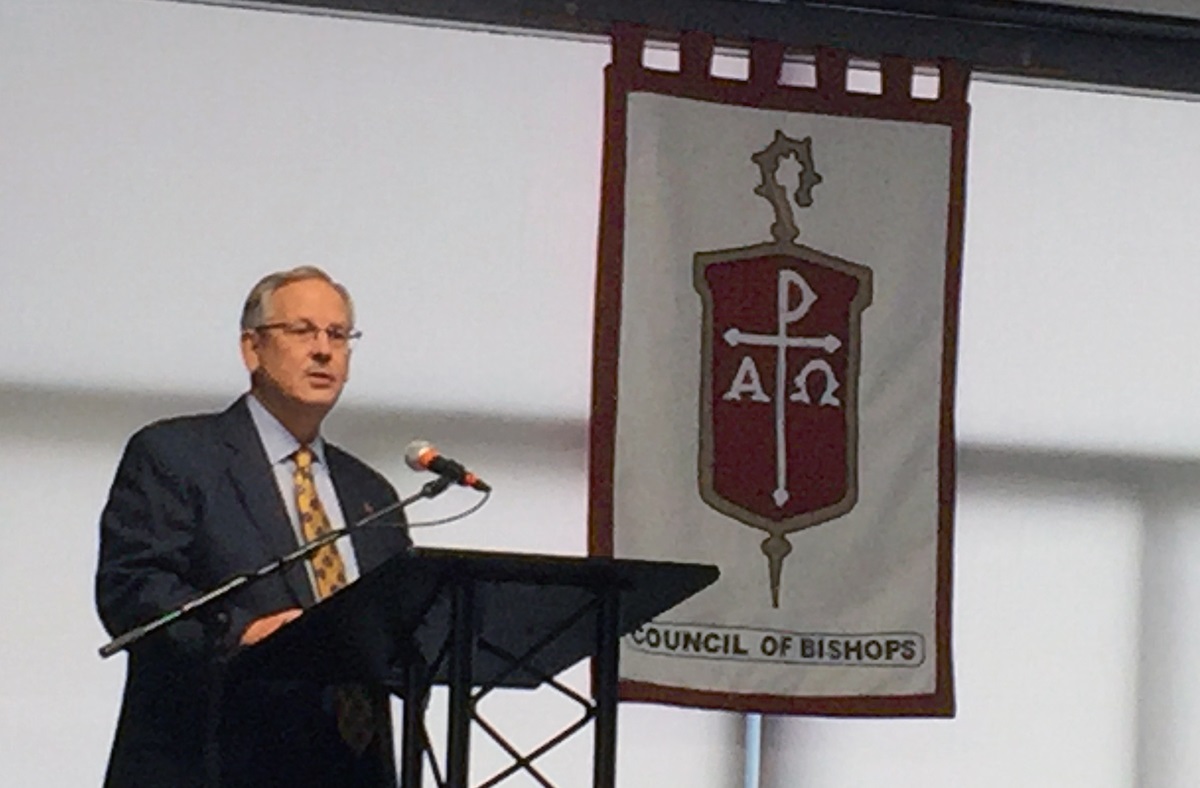
United Methodist bishops find themselves “off the map” as they try to navigate a way forward through the church’s impasse over homosexuality, said Bishop Bruce R. Ough.
“There is currently no larger or intractable barrier to the mission, unity and vitality of The United Methodist Church than the matter of homosexuality,” the Council of Bishops president said November 6, in his fall address to 127 of his episcopal colleagues. Ough also leads the Dakotas-Minnesota area.
Nevertheless, he expressed confidence that with “a rock-solid, Christ-centered core,” the church can find a way forward that “maintains unity, honors our distinctive Wesleyan connectional values and has the property of being continuously adaptive.”
He likened his fellow bishops to the U.S. explorers Meriwether Lewis and William Clark, who expected to navigate their way to the Pacific Ocean by canoe but found their path blocked by the rugged Rocky Mountains.
“The specific issues of same-gender marriage, the ordination of LGBTQ persons, and the underlying issues of scriptural authority and biblical obedience are our denomination’s Rocky Mountains,” Ough said. “And it is clear there is no way forward unless we are willing to rethink and redesign what a global United Methodist Church looks like.”
Ough spoke as the bishops were about to embark on multiple days of discussing the work of the Commission on a Way Forward. General Conference, the denomination’s top lawmaking body, authorized the bishops to form the commission after rumors of a possible church split over homosexuality reached a fever pitch.
The 32-member commission so far has held six of its nine planned meetings, and it has delivered its preliminary report to the bishops. The report remains under wraps, and the bishops are holding their discussions about the commission’s work behind closed doors.
Bishop Ken Carter, one of three episcopal leaders who serve as commission moderators, previously explained that the commission serves the bishops in an advisory capacity. The episcopal leaders are responsible for shaping the proposals that will go before the special 2019 General Conference, which will in turn determine those proposals’ fate.
The bishops last year established that the commission would look at possible structural changes with the goal of maximizing “the presence of a United Methodist witness in as many places in the world as possible,” allowing “for as much contextual differentiation as possible.”
Ough urged the bishops to be uncompromising in reviewing any proposed new structural models. He cited the “painful” example of one structure formed for political expediency — the Central Jurisdiction, which segregated African-Americans from much of the church. That jurisdiction formed with the merger of three Methodist denominations in 1939 and only ended with the 1968 formation of The United Methodist Church. Five geographically based U.S. jurisdictions remain.
“Many historians would argue that the formation of jurisdictional conferences in the United States was a similar structural compromise that has perpetuated sectarianism and disconnect within The United Methodist Church,” Ough said, to murmurs of assent.
He also urged the bishops to prepare local churches, conference leadership teams and, most significantly, the delegations to the special 2019 General Conference to imagine a new church.
“If we do not work with our respective delegations, so that they have a change of heart and are open to going to the called General Conference to be at peace rather than be at war with one another, we will fail,” he said.
The commission will continue meeting until next spring. The bishops plan to make their final recommendations at their May 2018 meeting.
“It will be our responsibility, and ours alone, to lead the adoption and acceptance of the recommendations,” Ough said.
Bishop Thomas J. Bickerton, who leads the New York Area, said Ough’s address “set the right context for our meeting today.”
Bishop José Quipungo, who leads the East Angola Area, agreed. He added that he thinks the bishops can find a way to navigate the church’s cultural and theological differences.
“My personal idea is that each place should focus on the problems we are facing locally,” he said. “We do not have the same ideas or same point of view. We do not have the same problems. But in all these differences, we are still together and we should go forward together.”
Ough also expressed his faith the church can stay united. He advised his fellow bishops to stay calm and surrender to God’s yearnings.
“Let’s let God be God,” he said. “And by all means possible, let’s stay connected to each other.”
Hahn is a multimedia news reporter for United Methodist News Service. Contact her at (615) 742-5470 or [email protected]. To read more United Methodist news, subscribe to the free Daily or Weekly Digests.
Like what you're reading? Support the ministry of UM News! Your support ensures the latest denominational news, dynamic stories and informative articles will continue to connect our global community. Make a tax-deductible donation at ResourceUMC.org/GiveUMCom.


