
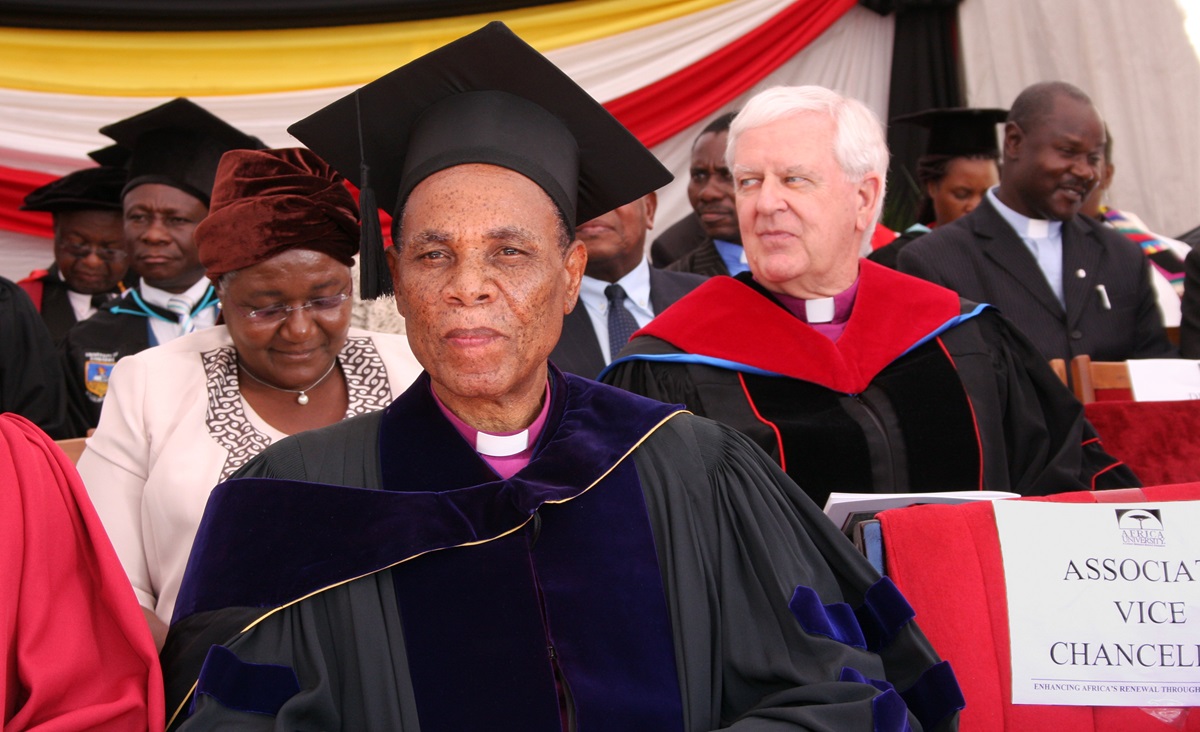
Established in 1992, Africa University will celebrate its 25th anniversary on March 25. In celebrating the anniversary of the pan-African university, Bishop Eben Kanukayi Nhiwatiwa, who has presided over the Zimbabwe Episcopal Area since 2004, shares his thoughts on the development, life and future of this United Methodist-related institution.
The bishop was one of the pioneering faculty members of Africa University. He reflected on the university’s 25 years with the Rev. Taurai Emmanuel Maforo, communicator for the Zimbabwe Area.
Bishop Nhiwatiwa, could you give a brief background on the location and establishment of Africa University in the Manicaland Province of Zimbabwe?
The establishment of Africa University in Manicaland in the valley of Old Mutare is indeed a dream come true. When the site-selection committee came to Zimbabwe as a whole, they had expectations. They wanted an area where there was a concentration of United Methodists. Old Mutare is where The United Methodist Church started in 1897 through the work of Bishop Joseph Crane Hartzell. In so doing, Zimbabwe met the criterion.
They also wanted a country where English was one of the business languages. Provision of the land was liberally made available through the initiative of Bishop Abel Tendekayi Muzorewa, who told the selection committee that the Zimbabwean church would donate whatever land was needed for establishing the university. So it was a great plus.
Then we have the general environment: A country of perpetual peace, as Zimbabwe is, was very helpful for the selection of this university to be established in the country, and particularly in Manicaland. The beauty of that region cannot be subtracted from the decision-making.
How is the above connected with the coming of the church in Zimbabwe?
Very connected! As I said earlier that Old Mutare is the pivotal center for the beginning of The United Methodist Church here in Zimbabwe, so there was going to be that connection and the university was not going to be an “orphan,” as it were.
Africa University was to be surrounded with the strong foundations of the church and indeed a thriving church in that region and as far as Zimbabwe as a whole is concerned. This is so considering the robust church infrastructure — Hartzell Primary and High schools, Fairfield Children’s Home and Old Mutare Hospital.
Africa University has its library named Jokomo-Yamada. What is the background?
Names are given for a purpose. Bishop Christopher Jokomo worked very much with the university as the chairperson of the Finance Committee. Not only that, he instituted the Africa University Sunday, which is observed annually by all the United Methodist congregations in Zimbabwe. That was very key support at the early stages of development of the university. Naming of the library after him was the university leadership’s way of saying thank you. Ken Yamada of the United Methodist Board of Higher Education and Ministry was instrumental in raising funds through various institutions such as USAID. He was very wise in his ways of engagement.
As a former faculty member of the university, share with us your joys as the institution turns 25.
If joys would be measured, no scale would remain without being broken. The joy comes when you see the leadership positions held by the graduates, not only in Zimbabwe but throughout the African continent — where our church is and even where we are not yet present. We are seeing people coming, being attracted by the quality of academics. It’s a joy to see the university growing. The university is making its mark and it has come of age.
In what capacity did you serve at the university?
I feel very humbled to say as pioneering staff, we started almost everything together with others. We would meet under the shade of trees — as we had no luxury of meeting in the boardrooms — and work to produce programs and curriculums of the university. We would work late into the night after lectures. We used the evenings to be the beginnings of the work to plan the life of the university. So when I look back, I see part of my life etched and blended together with the life of the university, and it is a constant source of tremendous joy.
In this present era, how have the Zimbabwean church and Africa University related as far as education provision and support is concerned?
I am very happy about what the church has been doing. Back to Bishop Muzorewa, providing land, the church was not stingy with the land. The way Bishop Jokomo led as a member of the board and the support through Africa University is a heritage which the bishops left. More recently, the church launched the Episcopal Scholarship fund, which already has the first two students. These are very evident ways of support. Our high schools are being directed to send students to Africa University. We have seen our clergy go there for their bachelor’s and master’s degrees. These are the basic ways of support.
And the relationship with Nyadire?
The Nyadire Teachers’ College relationship with Africa University is the icing of what is happening. The college is becoming the satellite college of Africa University and will see its very first degree program enrollment by August 2017. When you talk of celebrating 25 years you look at those developments as that which substantiate that the university has indeed grown.
With regard to the College of African Bishops, have they been involved in the life of the university? And the Council of Bishops?
The support of Africa University is anchored in the Council of Bishops and the African College of Bishops and in the church as a whole. The College of African Bishops has built a staff house at the school together with our laity. This is showing how happy we are. Most meetings of the College of Bishops are held at Africa University. This is our way of support that this is our institution, we will support and advocate for it.
Every two years, Pastors’ School and Laity Academies of the Zimbabwe Episcopal Area are held at Africa University. What does this mean for the church?
Just to be at a university tends to motivate everybody to bring the spirit of learning. This is a show of support the university. The little money we raise we want to direct to the university so that it can then enhance the educational programs. That is a very loud statement showing in a big way that we love and support our university.
Any words, Bishop, for those that have led and continue to lead Africa University beyond these 25 years?
The leadership of Africa University are leaders par excellence. They have always been a constant source of pride for the church. They are leaders who can stand high with any other leader you can think of. We now have Professor Munashe Furusa there who has already shown a mark. He is a very creative leader, a leader with foresight and vision. We say thank you to God for giving us this leadership and staff.
How do you see Africa University in the next 25 years?
Africa University will keep on growing and will keep on making its brand. Africa University will make people tilt their ears to hear what is the recent thing happening there. It will be the institution of our time and institution of our century and new things will start at Africa University and taken to the rest of Africa and beyond. I see more students graduating from there and more leaders being shaped as their motto says: “Investing in Africa’s Future.”
Whenever we talk about Africa University, it is described as a United Methodist-related institution. How does that make you feel as a leader of the church?
It should make us feel humbled. When I say we have a sense of pride, it is a pride of thanksgiving to our God who has led us. We were pioneers in having a charter for the establishment of a private university in Zimbabwe. The United Methodists should always know that we are pioneers in so many things. When we see that university, we therefore see us moving ahead.
Maforo is communicator for the Zimbabwe Area. News media contact: Vicki Brown (615) 742-5470 or [email protected]. To read more United Methodist news, subscribe to the free Daily or Weekly Digests.
Like what you're reading? Support the ministry of UM News! Your support ensures the latest denominational news, dynamic stories and informative articles will continue to connect our global community. Make a tax-deductible donation at ResourceUMC.org/GiveUMCom.


