
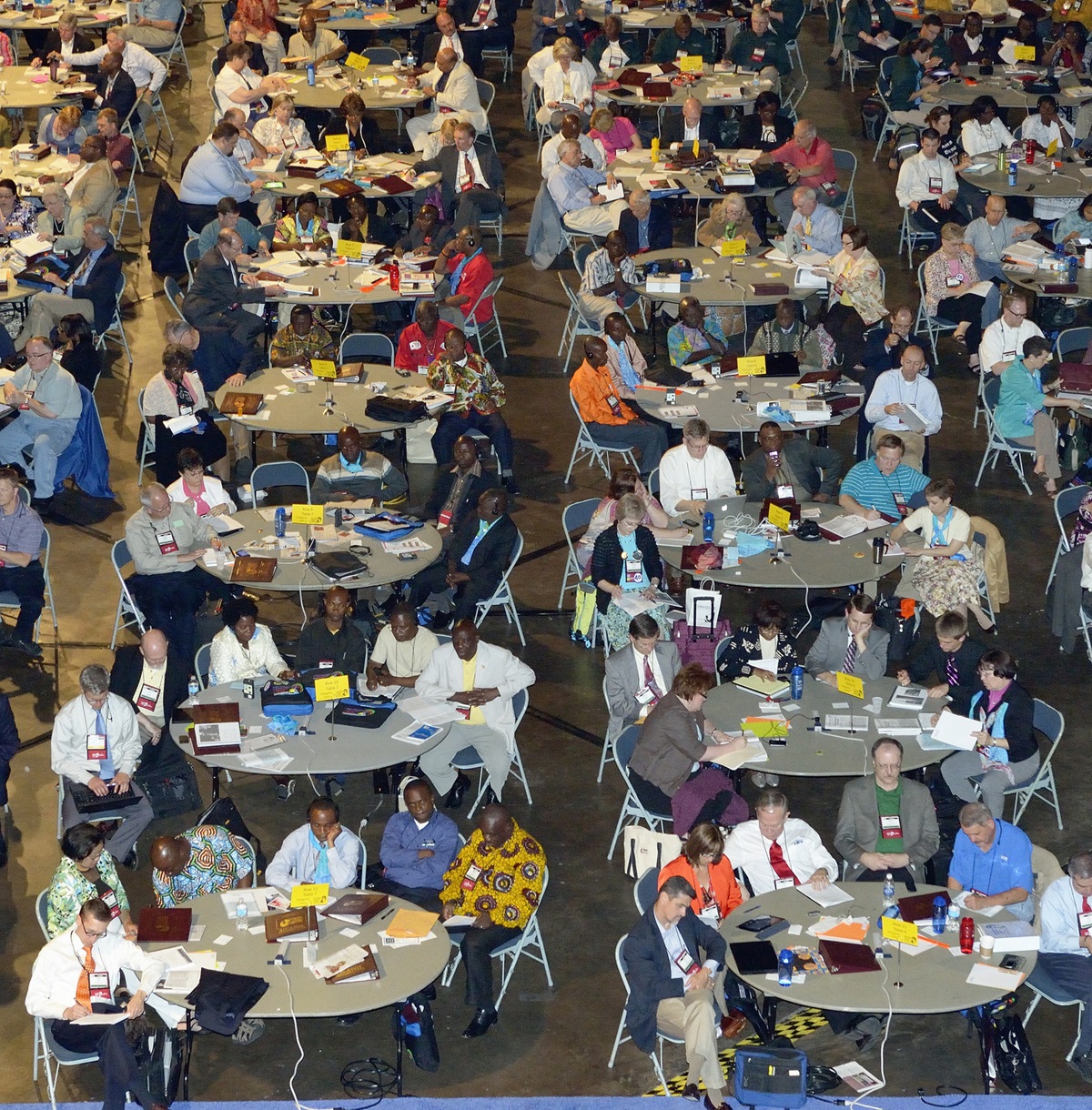
Delegates spent most of April 27 in 13 legislative committees, and in the evening they gathered for An Act of Repentance toward Healing Relationships with Indigenous Peoples.
The Superintendency Legislative Committee agreed to a proposal from the Council of Bishops seeking a constitutional amendment that would permit them to assign a bishop without a residential assignment to serve as council president. If approved by a two-thirds majority of the assembly, the proposal must still be ratified by two-thirds of all annual conference members voting on the amendment.
The General Administration Legislative Committee is assigned the massive task of reviewing all structure proposals. In a straw poll, 48 committee members expressed a preference for multiple agencies, and 35 favored the proposal from the Connectional Table that would place nine of the 13 agencies under a single governing body.
Committee members agreed to begin their work with Plan B, an organizational plan submitted by an ad hoc group of delegates that retains four program agencies, continues the General Council on Finance and Administration, and discontinues five general agencies and expenses of 372 board members.
This is only the beginning point. The plan will be changed before presentation to plenary sessions, which begin April 30. Plan B architects already changed their original proposal to allow United Methodist Communications to remain a separate agency. Even if the legislative committee proposes a revised Plan B, a few delegates expect a minority report supporting the Connectional Table plan to be submitted alongside the majority report.
Space and language difficulties
While some committees are meeting in large ballrooms that provide adequate space for subcommittee meetings and visitors, other committees were assigned smaller quarters that limit the number of visitors and make dividing into subcommittees difficult.
The Rev. Mark Holland, a pastor from Kansas City, Mo., said the room assigned to the Judicial Administration Legislative Committee was so small that sounds from the two subcommittees made it difficult to hear.
One of the subcommittees moved outside.
Once outside, Tampa Bay traffic still made hearing difficult, and a helicopter landing on the top floor of a nearby hospital stopped conversations entirely.
The subcommittee attempting to rewrite procedures for handling clergy trials is always accompanied by three translators.
"This is impossible in one language now four," said Holland in a blog. "It can be done, but the time frame and sheer volume have to be addressed."
An increased number of non-English-speaking delegates has resulted in frequent calls for speakers to slow down to enable translators to keep pace.
The issue of homosexuality
The issue of homosexuality continues to surface in a variety of ways during the gathering.
Following nominations for Judicial Council and University Senate during the evening plenary on April 26, Mark Miller, an openly gay delegate from the Greater New Jersey Annual (regional) Conference, asked for a point of personal privilege.
"I am offering my voice to say that the attempt at holy conversation about human sexuality yesterday was incomplete," said Miller. "We were bullied emotionally, spiritually and physically and it didn't seem like anyone did anything."
After several delegates rose to put their hands on his shoulders during his impassioned plea for greater openness, Bishop Robert Hayes Jr., the presiding officer, ruled him out of order.
"Will you pray for us?" asked Miller. "I will certainly do that," said Hayes.
"We pray for all those who have been injured and bruised and hurt and bullied," Hayes said. "And we pray this General Conference that we'll continue to make sincere attempts to bridge the divide that separates us theologically, psychologically and socially."
An extended debate on the rules resulted in abbreviated time for holy conversations. In an interview later, Minnesota Area Bishop Sally Dyck said it was "very, very unfortunate" that there wasn't enough time for the holy conversations. "It is an issue that just truly seems to fracture the church, and that's why we wanted to have some time of holy conferencing," said the bishop, who led plans for the conversation on human sexuality.
Miller later met privately with a number of General Conference officials.
"We hope for a community of love," said the Rev. L. Fitzgerald "Gere" Reist, secretary of the General Conference and one of the people who met with Miller. "Sometimes our understanding of God's law gets in our way of our understanding of God's love."
A silent witness
Delegates leaving the April 26 evening worship filed through lines of some 300 people with colorful stoles marking their support for efforts to change current laws forbidding the ordination of homosexuals and the conducting of same-gender services of union.
As the delegates left the assembly hall, a few stopped to hug participants or join the demonstrators.
After most of the delegates had left, the demonstrators began singing softly, "We are gentle, angry people, and we are singing singing for our lives."
No unusual problems
UMNS asked the Rev. Alan Morrison, manager of General Conference, if there were any particular problems that had emerged to date. "Nothing out of the ordinary," said Morrison. "No one has suffered a heart attack."
A few problems with keypads with low batteries emerged early in the first plenary session, and the level of microphones had to be adjusted. Despite some hi-tech visual effects, technical problems have been at a minimum.
An underappreciated computer system, called the Conference and Legislation Management System (CALMS), enables recorders in each legislative committee to enter the approved or revised petitions (now called calendar items) into the Daily Christian Advocate.
"This is the third General Conference we have used the system," said Mike Cunningham, CALMS administrator. "We have honed it to a fine operating application that legislative recorders find easy to use."
*Peck is a retired clergy member of New York Annual Conference attending his 12th General Conference, four times as editor of the Daily Christian Advocate and three times as a member of the UMNS news team.
News media contact: Tim Tanton, Tampa, Fla., (813) 574-4837, through May; after May 4, Nashville, Tenn. (615) 742-5470, [email protected].
Like what you're reading? Support the ministry of UM News! Your support ensures the latest denominational news, dynamic stories and informative articles will continue to connect our global community. Make a tax-deductible donation at ResourceUMC.org/GiveUMCom.


